

Dramatic Arts
Do you crave the vibrant energy of live performance, and find yourself singing the latest musical theatre songs or acting out scenes in your head? Young Actors at Idyllwild Arts live in a space where ideas, stories, and characters come to life. Our expansive, interdisciplinary curriculum offers students an entire spectrum of Dramatic Arts including acting, musical theatre, production and design or general theatre; creating fully-realized, well-rounded performers and technicians confident in their own abilities and ready for the next level.

Philosophy
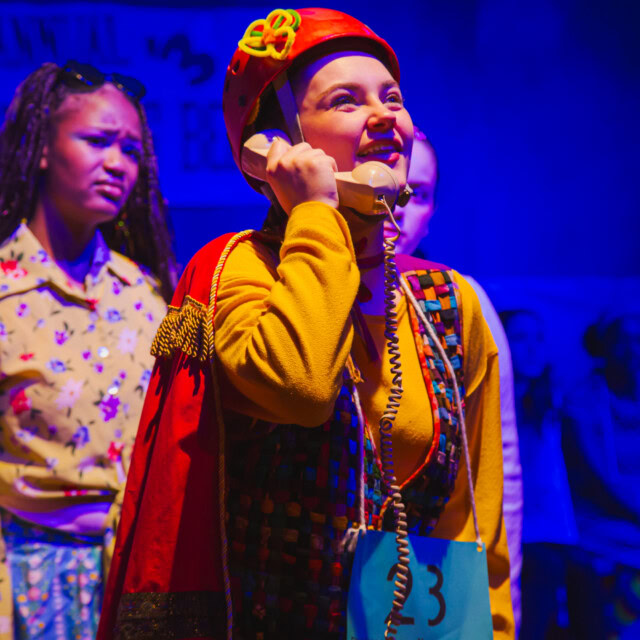
Magic happens when artists come together, weaving tales that inspire, entertain, and challenge audiences. The Dramatic Arts major encompasses more than just the actor’s spotlight—our students explore the full depth and breadth of the discipline, collaborating as actors, singers, dancers, lyricists, technicians, and crew members to assemble all of the elements of a professional stage production as well as the actor’s role in front of the camera.
Concentrations
Dramatic Arts majors declare an area of concentration in Acting, Musical Theatre, Design & Production or General Theatre at the time of admission, which shapes the curriculum they receive.
No matter the focus, Dramatic Artists will collaborate, perform, produce, and demonstrate their skills on and off campus in a variety of main stage performances, showcases, competitions.

Musical Theatre Concentration
The Musical Theatre concentration provides high-level triple-threat training for multi-talented student Actors who sing, dance, and act. On top of the intensive performance training that distinguishes that Musical Theatre concentration, students receive additional cross-departmental training with music and dance faculty for voice, music theory, tap, ballet, and jazz, empowering students to captivate audiences.

Acting Concentration
In the Acting concentration, students develop their craft to reach new heights of artistic expression. Acting for Stage & Screen connects the foundation of classical theatre with innovative training for contemporary performing artists including on-camera techniques, voice over and much more. With some highlights like scene study, character development, text analysis and improvisation, our expert faculty emphasize the Acting techniques that can make characters real, authentic and alive.

Design & Production Concentration
The Design & Production concentration focuses on the technical aspects of theatre and live performance, including stage management, set, lighting, sound, and costume design. Hands-on experiential learning and the guidance of our expert faculty, students become highly capable production designers who create visually and audibly stunning productions.

General Theatre
The General Theatre concentration allows students to pick and choose classes from within the entire Dramatic Arts offering, enabling them to explore all the department has to offer.

Dramatic Arts Curriculum
Our robust curriculum and agile approach provide a rigorous Dramatic Arts education on par with liberal arts college and conservatory programs, powered by our distinguished and dedicated faculty. Students select pre-professional training in musical theatre, acting for stage & camera, directing, playwriting, production & design to name a few, developing the skills and knowledge to succeed in the pursuit of conservatory, college or a professional career in the industry.
Full-Year Course
Prerequisites: none
Acting for the Camera examines the technique of acting as applied specifically to film. It is offered for the advanced acting student. Students develop on-camera skills to move effectively between plays, commercials, soap operas, television, and film. Placement is at the discretion of the faculty.
One-Semester Course
Prerequisites: none
The objective of Acting the Song is to help learn and develop the concepts of singing musical theater songs from an Acting POV. We will discuss picking the song that fits their type, voice, range, and performance techniques of the solo musical theater vocal repertoire and the resources to find songs to sing. Students will work one on one with the instructor in a masterclass setting to workshop their songs through Acting and vocal technique. At every class session, each student will have the opportunity to work on their songs in the class in some fashion. We will do all of the work needed to develop a process when approaching a song beyond just the notes. This is a learning environment where all students are encouraged (regardless of level), and an atmosphere created that allows all students to embrace their performances with freedom, agility, and most importantly, meaning. You will need tracks to play as we get further into the semester.
One-Semester Course
Prerequisites: none
Acting Improvisation teaches the improvisational techniques needed to inspire spontaneity and creativity. Non-majors may enroll with the instructor’s permission. This course focuses on long-form improvisational acting techniques, with emphasis on skills needed to create characters, relationships, scenes, and performance pieces based on the truth of the moment.
One-Semester Course for Quarter Credit
Prerequisites: none
Acting Improvisation teaches the improvisational techniques needed to inspire spontaneity and creativity. Non-majors may enroll with the instructor’s permission. This course focuses on long-form improvisational acting techniques, with emphasis on skills needed to create characters, relationships, scenes, and performance pieces based on the truth of the moment.
Full-Year Course
Prerequisites: none
Acting Seminar (Honors) continues training and develops craft and technique by re-emphasizing the fundamentals of listening, inner truth, action, obstacle, etc. This course also introduces different techniques to give bold, believable awareness and acceptance, and understanding of the body and voice as tools for creative expression. This class addresses the discovery and use of a personal working process and challenges the student to overcome acting blocks and habitual limitations. Advanced scene work is undertaken through relaxation, concentration, objectives, conflict and moment-to-moment living, requiring greater specificity, personalization, and commitment. The students’ intellectual and emotional resources are tested. Students are expected to research their characters and the social, political, and physical worlds in which their characters exist.
One-Semester Course
Prerequisites: none
In Audition Techniques students are developing and practicing the important skills and techniques required to audition for all aspects of the industry: on camera, live theatre and/or college auditions. The focus of each course depends on the faculty and focus in any given semester.
Full-Year Course
Prerequisites: none
In Company Acting/Technical students are placed in Company-Acting or Company-Technical Theatre and participate in main stage performances. Students are shifted within Company-Tech and Company Acting according to production needs, casting, etc. Placement in Company is by audition only and is based on achievement, skill, maturity, and readiness to handle the work. In this course the student learns various aspects of technical production for performance. Students are assigned to a variety of crews, including but not limited to: scene shop/lighting crew, properties, costume construction crew, running crew, etc. Students are assigned on an as-needed basis for each production and placement is at the faculty’s discretion.
Full-Year Course; Various Disciplines including Ballet, Jazz, Styles, Tap
Prerequisites: none
Dance for Theatre introduces various styles of Musical Theatre dance. This course is required of Musical Theatre concentration students. Each variation is offered when staffing allows. This course may be considered for PE credit.
One-Semester Course
Prerequisites: none
Design Elective provides specific instruction in the varying disciplines of technical theatre. Topics vary from year to year and may include studies in advanced theatrical design, make-up design, computer aided design, scene painting, film and television production technique, history of costume or decor, etc. Offered when enrollment permits.
One-Semester Course
Prerequisites: none
Design/Tech Lab offers design and technical production students the opportunity to explore individualized curricula in the area of design and technical theatre. This course may include but is not limited to modeling and rendering skills, painting techniques, new technologies, and sound and light operations and design.
Full-Year Course
Prerequisites: none
Design for Theatre teaches the design process for all elements of theatre. It begins with script analysis and includes collaboration, concepts, design styles, and the responsibilities of the designer. Students produce sketches, color renderings, drafting and scale models, light plots, and any associated paperwork that may eventually be used in their portfolios. Because the emphasis changes every year, students may repeat this course for credit.
Full-Year Course
Prerequisites: none, but open to returning seniors only.
Directing examines the application of directing and staging techniques. Included are the fundamentals of blocking, script analysis, achievement of emphasis, and the development of aesthetic values. The class teaches the principles of directing, staging, analysis, director/actor communication, the balance between truth and technique, and the performance process itself.
Full-Year Course
Prerequisites: none
Drafting for Theatre teaches the fundamentals of drafting, including basic drafting equipment, development of proper technique, and use of scale and industry standards. Because the emphasis changes every year, students may repeat this course for credit.
One-Semester Course
Prerequisites: all audition costs are the responsibility of the student (airfare, hotel, food, audition fees, etc.)
Independent Study (Audition/Portfolio) helps the student prepare for the rigors of college auditions. This self-motivated class provides the tools needed for successful presentation through the art of the monologue. Students may opt to attend the Unified Auditions, held in Chicago in February. The Unified Auditions are conducted by about 35 college/conservatory theatre programs. Dramatic Arts faculty accompany students to the auditions. Successful completion of preparatory work is required and attendance at the Unified Auditions is at the discretion of the faculty. Independent Study (Audition/Portfolio) is required of all Dramatic Arts seniors.
Full-Year Course
Prerequisites: none
Introduction to Design teaches the basic principles and methodology of theatrical design. This survey course includes studies in developing concepts and approach statements, usage of materials, and production research.
Full-Year Course
Prerequisites: none
Musical Theatre Repertory examines the development of Musical Theatre from the English Music Hall to the contemporary musical through academic study. The styles and periods of Musical Theatre development are also examined through listening and singing as well as presentation of the material. The class teaches the skills needed to prepare and present songs from the repertory. Audition material and ensemble singing are incorporated into the course. Depending on enrollment, beginning and advanced levels of this class may be offered and placement in levels is at the discretion of the faculty. Students may repeat this course with consent of the instructor. Each student is required to perform regularly in Musical Theatre Repertory Class.
Full-Year Course
Prerequisites: none
Music Theory is a series of two courses required for all Musical Theatre students. Music Theory teaches how music is built, organized and written through the prism of the Musical Theatre genre. The Actor will learn the ‘grammar’ of music. The course seeks to share a common language that will help students in any Musical Theatre rehearsal. The course seeks to share the steps to sight-reading, ear training, rhythm and vocal score analysis. Designed for performers, it focuses on quick melody learning, character cues from the music and seamless collaboration with music directors during auditions and rehearsals.
Full-Year Course
Prerequisites: none
Performance Practices is an ongoing intensive course of study in the acting craft. It includes the study of stage deportment and usage, script/character analysis, improvisation, ensemble, and monologue work. The work concentrates on self-awareness/acceptance and the understanding of the body and voice as tools for creative expression. The course also addresses the discovery and use of a personal working process. Multiple sections are offered. Students are placed in class at the discretion of the faculty.
One-Semester Course
Prerequisites: none
Performing Shakespeare introduces qualified actors to the work of the great playwright. Through readings, lectures, exercises, and scene-work, actors learn to play verse with clarity and energy. They learn to understand Shakespeare’s language and to cull the imaginations of his characters while animating and expressing his ideas and objectives. Offered when enrollment permits.
Full-Year Course
Prerequisites: none
Physical Storytelling helps develop physical movement skills for theatrical performance. The class teaches clear expression of character through movement and physicality and explores the body’s range of movement and its potential to communicate. Theories of movement studied include the Meyerhold, Alexander, Grotowski, Laban, and Margolis techniques. Exercises address free-form movement, ritual movement, head body connection, character building, and storytelling through movement, supplying a wealth of tools for fully-realized character work.
Full-Year Course
Prerequisites: none
Practicum is required of all Theatre majors every year. Every Theatre major is enrolled in Practicum each semester. Students must complete fifteen hours of work per semester. Department assignments may include stage management, performance ushering, and/or other service opportunities. Attendance at all department strikes is mandatory and hours are recorded to fulfill part of the Practicum requirement.
Full-Year Course
Fees: Please reference the current Financial Supplement on the Enrolled Student Resources Page for details.
Private Voice Lessons develop free and healthy vocal production, skilled breath management, resonance, and projection. Students expand their knowledge of vocal literature, traditions, and informed diction usage. The goals are development of productive practice routine and memorization skills, growth in musicianship, confidence, and truthful delivery of text, resulting in complete and communicative performances. Teacher assignment is made by the Music Department faculty. Private lessons are required of all junior and senior Theatre majors with Musical Theatre concentration. Non-Musical Theatre majors may request private voice lessons with consent of Theatre faculty.
One-Semester Course
Prerequisites: none
Production Design, offered jointly by the Theatre and Film Departments, explores the role of the production designer in the art of the motion picture. Both aesthetic and technical considerations are considered, as well as how a production designer works with the director. Topics include set design, set construction, and scenic painting.
Full-Year Course
Prerequisites: none
Production Seminar explores the process of mounting a production, beginning with selecting an appropriate script and continuing through actual performance. Students fill all positions required for the performances.
Full-Year Course
Prerequisites: none
Production Skills is a hands-on class devoted to procedures in production and support of the performing arts departments across the campus. Students may assist all special events that require technical support. All work is done in on- and off-campus performance venues. Students also support campus audio/visual set ups and presentations. Students learn basic stage management, lighting design and practices, and audio engineering.
One-Semester Course
Prerequisites: none
Radio Drama/Voice Acting is a course designed to develop skills for the microphone and the recording studio in voice-over work, in podcast and radio drama, in audio books, and in other non-singing voice work. Students will become familiar with industry protocols, microphone techniques, and theatrical conventions. They will learn breathing and movement exercises to reinforce their comfort, health and skill levels in a recording environment. They will learn to perform scripted material of various lengths and genres, and will also learn basic, analogue sound effects.
One-Semester Course
Prerequisites: none
Scene to Song is a course designed to reinforce the idea that performing in musical theatre is storytelling. The course explores techniques to transition seamlessly between spoken dialogue and the lyrics of a song. The course helps to develop Acting choices, breathe control, emotional beats and musical phrasing.
One-Semester Course
Prerequisites: none
Singing Duets, Trios & Quartets explores and develops the skills required to be a skilled Musical Theatre Artist. The faculty will take the students through a process using various techniques to a personal process of development in this area of singing. Students are expected to work outside of class with their partners to develop the songs they are working on.
One-Semester Course
Prerequisites: none
Stage Combat introduces the techniques of hand-to-hand, rapier, and broadsword, emphasizing safety, notation, choreography, masking, and performance. Offered when enrollment permits. May be considered for PE credit.
Full-Year Course
Prerequisites: none
Stage Diction provides students with a practical approach to improving the speaking voice through practices in breath support, vocal variety, and articulation. Principles of mature and effective use of the voice and speech mechanism, with individual instruction and practice in voice and speech improvement, teach greater ease in voice and speech performance. Students also become more skilled in critical listening and analysis of others’ voices. Emphasis is placed on articulation: speaking clearly and intelligibly; eliminating such defects as breathiness, nasality, harshness or stridency; building adequate support; achieving effective vocal variation, pitch, and speaking rate; correcting pronunciation; and modifying regional or foreign dialects.
One-Semester Course
Prerequisites: none
Stage Management explores the stage manager’s vital role in production. It includes text study and practical experience, giving students an understanding of production’s many technical components. Standard organizational procedures, scheduling, budgeting, production, safety, the supervision of crews, and the running of rehearsals and performances are the course’s fundamentals.
One-Semester Course
Prerequisites: none
Special Topics provides specific instruction in an area of specialization related to theatre performance. Topics vary from year to year and may include topics such as: radio drama, voice over techniques, or artist as entrepreneur. Offered when enrollment permits.
Full-Year Course
Prerequisites: none
Technical Theatre offers an orientation to technical theatre procedures and a general overview of technical theatre production.
Full-Year Course
Prerequisites: Technical Theatre and permission of technical director
Honors Technical Theatre Seminar, an advanced course for Theatre majors only, is an in-depth study of trends and standard practices in technical theatre. Students create and develop a play’s complete design package. They produce renderings, models, and paperwork for the project. The materials they generate are included in their portfolios. Independent thinking and self-motivation are crucial.
Full-Year Course; Successful Completion Required for Arts Certificate
Prerequisites: none
Theatre History surveys the history of theatrical productions and their cultural contexts, covering Greek and Roman theatre as well as Medieval, Elizabethan, Restoration, and Modern drama, and incorporating study of the art, architecture, and dress of each period. The Actors will explore the various styles of performance through these historical periods. They will also connect our current day artform to these various styles. Theatre History is required of all juniors and newly admitted seniors. Successful completion is required for a Dramatic Arts certificate.
Full-Year Course
Prerequisites: none
Vocal Clarity explores the theory and practice of vocal production and speech. It incorporates Fitzmaurice and Linklater voice work, techniques, exploring body and breath awareness, vibrations, amplification, jaw tongue, soft palate, resonators, breath capacity, and articulation. Students become fluent in the American sounds of the International Phonetic Alphabet (IPA), applying IPA to learning a standard American dialect and other dialects, as well. The class focuses on the voice and its connection to the mind (impulse), emotions, and body.
One-Semester Course
Prerequisites: none
Voice & Movement is a class for Actors and is specialized training. It helps performers build physical and vocal awareness, flexibility and control. These classes teach Actors how to use their bodies and voices as expressive instruments to create believable characters on stage or screen.
Master classes, workshops, and lecture demonstrations by artists in the following fields may be given:
- Acting
- Agents
- Audition
- Casting
- Children’s Theatre
- Design
- Directing/Producing
- Fencing
- Make-up
- Meeting the Industry
- Mime
- Photography


Opportunities
- Four Main Stage Productions each year (two musicals & two plays)
- Numerous additional performance opportunities each year including a new student showcase, cabarets, a touring children’s musical, staged readings of student plays, a collaborative “Winter Quilt” performances with students from other departments, and more
- Film Projects in collaboration with our Film & Digital Media Department
- Arts Enterprise Laboratory Projects (grant funded/student driven opportunities)
- Jimmy Awards,
- Lucie Arnaz Awards
- English Speaking Union Shakespeare Competition
- Spotlight Competition
- National YoungArts Competition
- …and more!
Notable guest artists regularly visit campus to teach classes; past teachers include:
- Marvin Hamlisch (Oscar, Emmy, Grammy, and Tony Award-winning composer)
- David Mamet (Pulitzer Prize-winning playwright)
- Marni Nixon (voice-over soprano for My Fair Lady, The King and I, and West Side Story)
- Mara Wilson, (actor, Matilda and Mrs. Doubtfire)
- …and many more!
Ongoing auditioning opportunities including the Chicago Unified Auditions for 12th grade and Postgraduate students, placing their talent in front of top colleges and conservatories
Audition/Portfolio Requirements

Denis McCourt Stryjewski
Dramatic Arts Chair
Dramatic Arts
951.659.2171 x2206
dstryjewski@idyllwildarts.org
Jeff Bell
Musical Theater Faculty and Music Director
Dramatic Arts
951.659.2171
jbell@idyllwildarts.org

Trevor Holmes (Dramatic Arts '05)
Dramatic Arts Faculty
Production and Technical Design Director
Dramatic Arts
951.659.2171 x2241
tholmes@idyllwildarts.org


Andrew Leeson
Music, Dramatic Arts and Creative Writing Faculty
Dorm Parent
Dramatic Arts, InterArts, Music
aleeson@idyllwildarts.org

Hai Cohen
Dance & Musical Theatre Faculty
Dance, Dramatic Arts
951.659.2171 x2235
haicohen@idyllwildarts.org

Jonathan Sharp
Dance & Musical Theatre Faculty
Dance, Dramatic Arts
951.659.2171 x2236
jsharp@idyllwildarts.org


Featured College Acceptances

California Institute of the Arts (CalArts)

Liverpool Institute of Performing Arts

Carnegie Mellon University

NYU Tisch School of the Arts

University of Southern California (USC)

Fordham University
Featured Dramatic Arts Alumni

Mara Wilson, 2005
Actor

Dylan Arnold, 2012
Actor

Ace Eure, 2002
Director

Celeste Headlee, 1987
Radio Show Host

Josh “Caleb” Eberhardt, 2008
Singer, Actor

Clayton Alexander
Dramatic Arts – ’94
